Search

oysters and arugula

Author

kaleary

We’re Going!

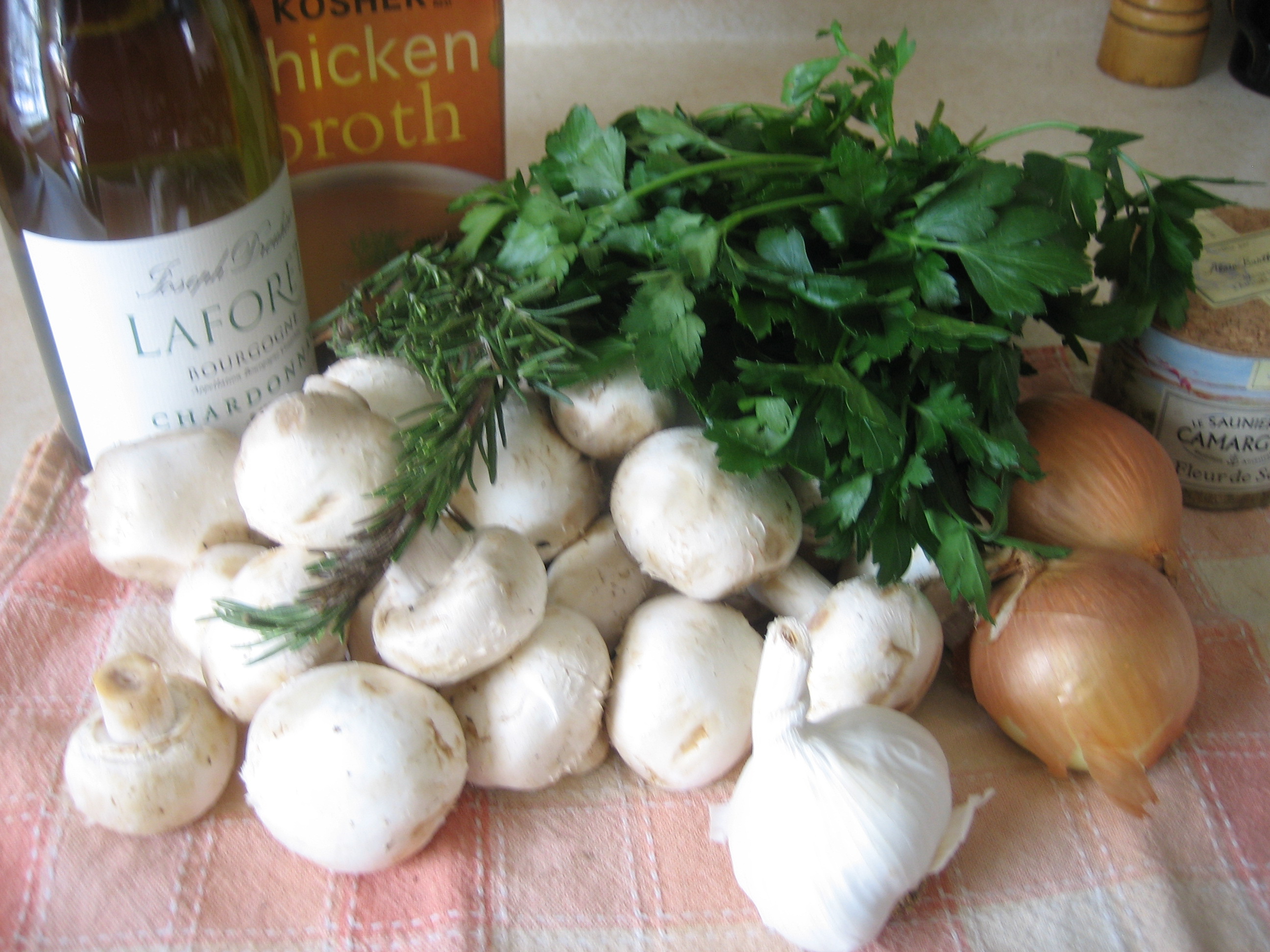
Four short weeks from today, my girls and I will be wandering the streets of Paris!  The winter prices were simply too good to pass up, and so our family Christmas present this year was a long weekend trip to Paris.   For these next few weeks, I’m going to try to focus the blog on all things French.  Beginning with yesterday’s lunch – Paris Mushroom Soup, which just happens to be one of the recipes I’m supposed to cook during January for Dorie Greenspan’s French Fridays group.

It was a bitingly cold day here in northern New Jersey, and in addition to something French, something warm was called for.  The fact that there were mushrooms involved made it an even easier choice, knowing, as I did, that it would be eaten by at least one mushroom lover.  As with most of the other Around My French Table recipes that I’ve tried so far, this one calls for relatively few ingredients (onions, garlic, mushrooms, rosemary, parsley, white wine, and chicken stock) and is prepared easily and quickly.  An extra bonus is the smell that will greet you when you return from running outside to the car, if you have left the soup simmering away on top of the stove in the meantime.  Serve this soup with a crusty peasant bread and a peppery arugula salad, and you (and your guest) will be happy.

Lentils for Luck

In Italy, lentils are believed to bring good luck, particularly if eaten as the first meal of the New Year.  And Signora Salvadore, with whom I lived during my semester in Florence, reminded me each time she served lentils for dinner, that when I someday had children, I must feed them lentils to keep them healthy – “piena di ferro!” – “full of iron!”, she would tell me.

I have followed her advice, and my daughters are huge lentil fans, as am I.  We eat a big bowl for lunch with bread and butter on a cold day, or over pasta for a quick dinner.  But I think I like them best with salmon.

Desirous of a little more luck in 2011 than I had in 2010, and in need of a menu for a special evening last week, I turned to Dorie Greenspan‘s roasted salmon and lentils, from her new book Around My French Table.  It being a work night, and there having been a little space of time since my guest and I had an evening together, this was the perfect recipe.  I could prepare the lentils on Wednesday night – toss them in a pot with some vegetables and chicken broth – and merely reheat them while the salmon roasted on Thursday night.  An arugula salad with a little blue cheese would round out the meal.

Dorie’s recipe worked like a charm! (As a member of her French Fridays with Dorie cooking group, I cannot give the recipe here, but I strongly recommend taking a trip to your local bookstore to pick up a copy.)  Dorie is certainly not the first person to offer a salmon and lentil recipe, but this one is terrifically basic while sacrificing nothing in flavor.   The moral of this little story?  I did my part to fortify us with luck and good health AND there was still plenty of evening left for catching up.

Baked Apples


On a chilly morning one month ago, my beau and I awoke to the smell of coffee, bacon, and warm apples, the perfect recipe for luring us from our quilt-covered bed and down to the dining room of the King’s Cottage Inn for breakfast.


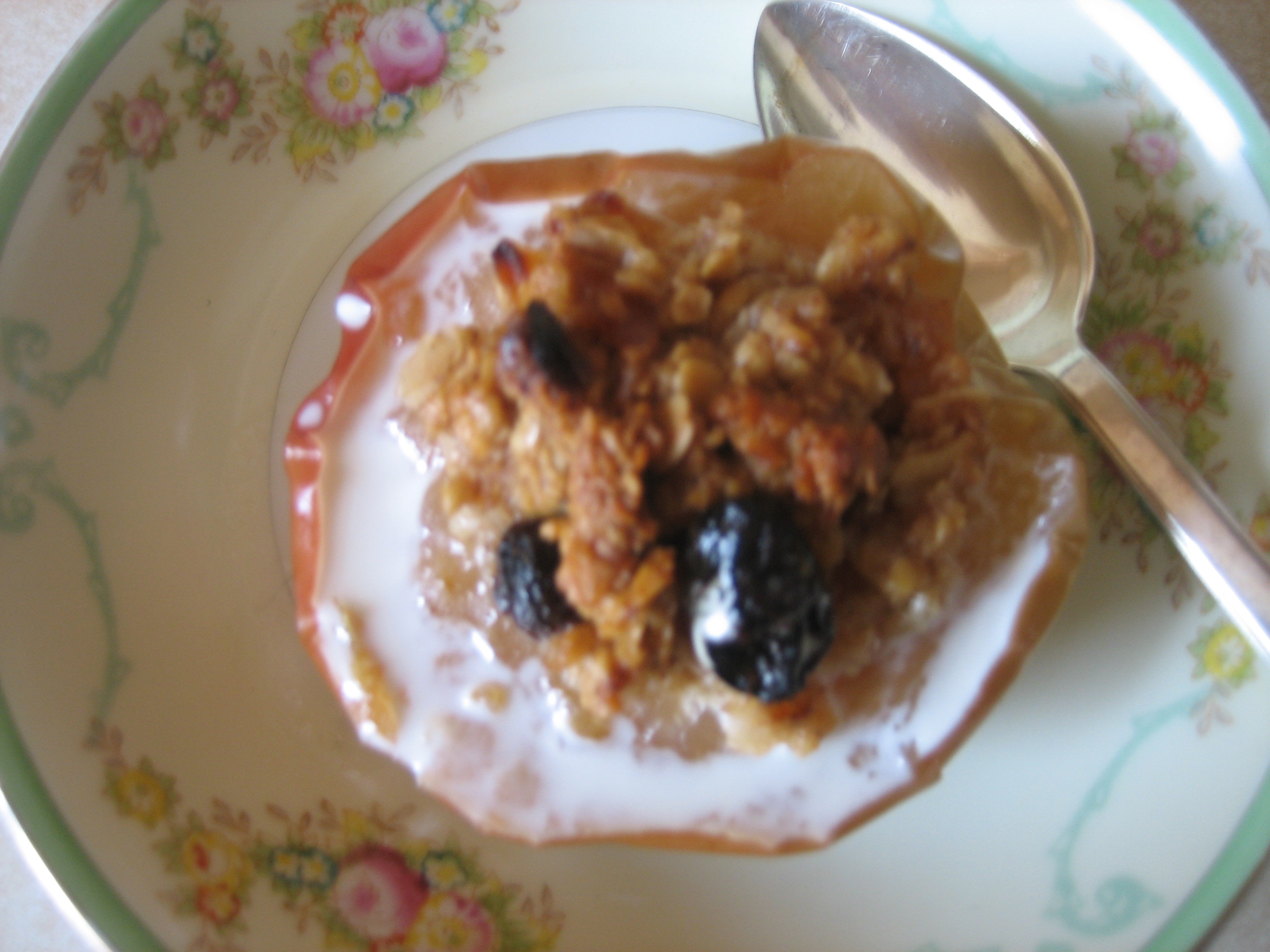
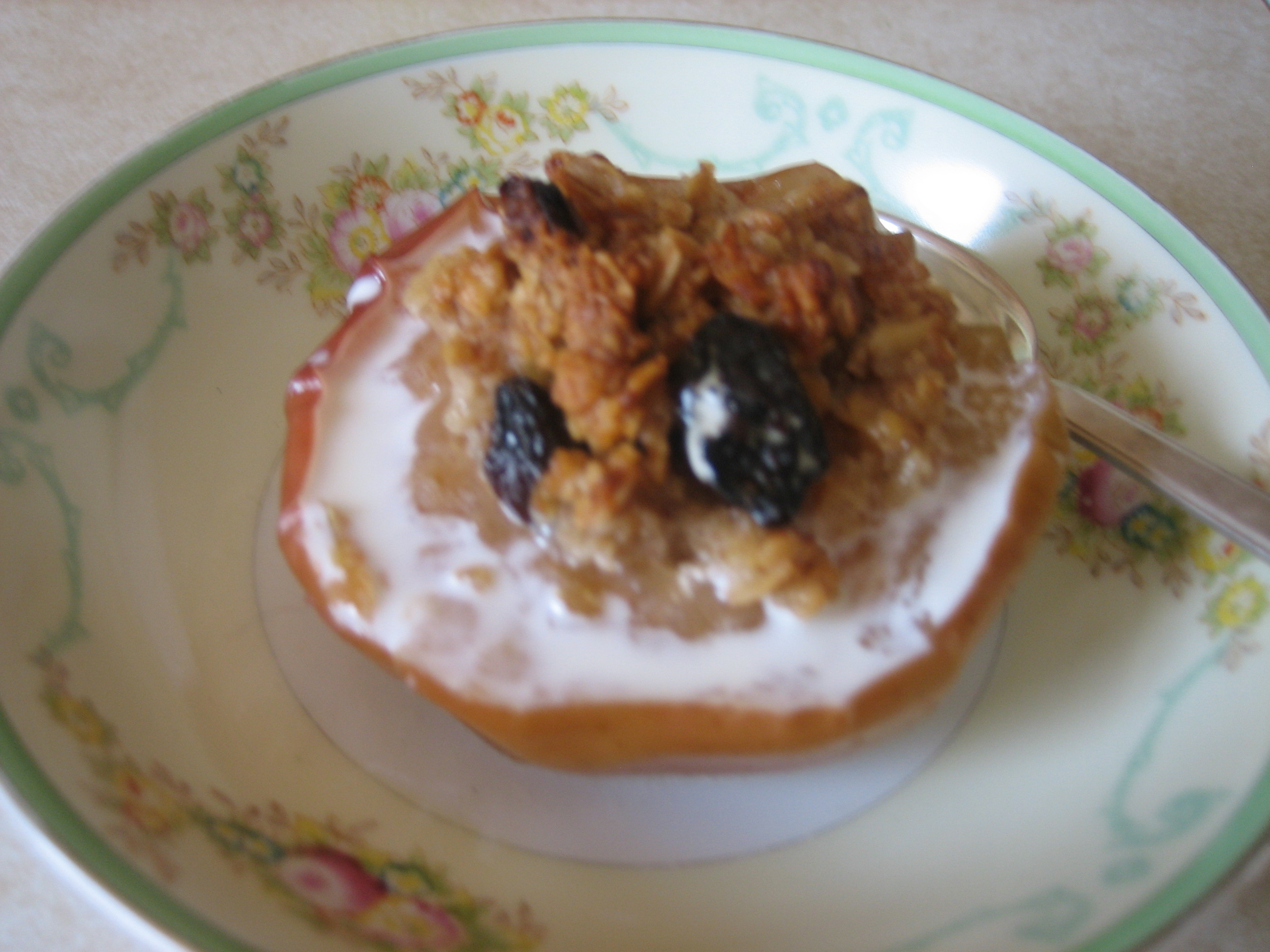
We had just taken a few sips of our coffee, and wished a Happy Anniversary to each of the two other couples in the room (one a 2nd, the other a 13th, while we kept mum about our 2-Month), when our hostess set before us the source of that lovely apple scent that had drifted up to our room – a baked apple.   Its center was filled with a mixture of oats, almonds, and cinnamon, and we both agreed that it was a perfectly cozy way to begin the day.   Never before this day had I been served a baked apple, and I now had to wonder why.  It seemed a relatively simple and fuss-free sort of thing, and yet there was a not-everyday-ness to it that I knew my daughter Greta would love.  I made a mental note to introduce this to our breakfast menu one day soon.

New Year’s Day turned out to be that day.   I devised my own recipe that morning, with what I found in my pantry, but having taken a look at the suggestions in The Joy of Cooking, it’s clear that one can go many ways with a baked apple – from basic with just brown sugar and cinnamon to a richer version involving almonds, figs, breadcrumbs and ginger to a savory sausage number.  But below you’ll find my version of the apple we ate in Lancaster, and proving that old saw, “Mother knows best,” Greta was delighted with the result.

Baked Apple Chez K

2 apples (I used Gala)

a little heavy cream (though milk will certainly do)

a little milk

1 Tbs. butter

1 pkg. instant oatmeal  (I used apples and spice flavor)

raisins, if you are so inclined

cinnamon

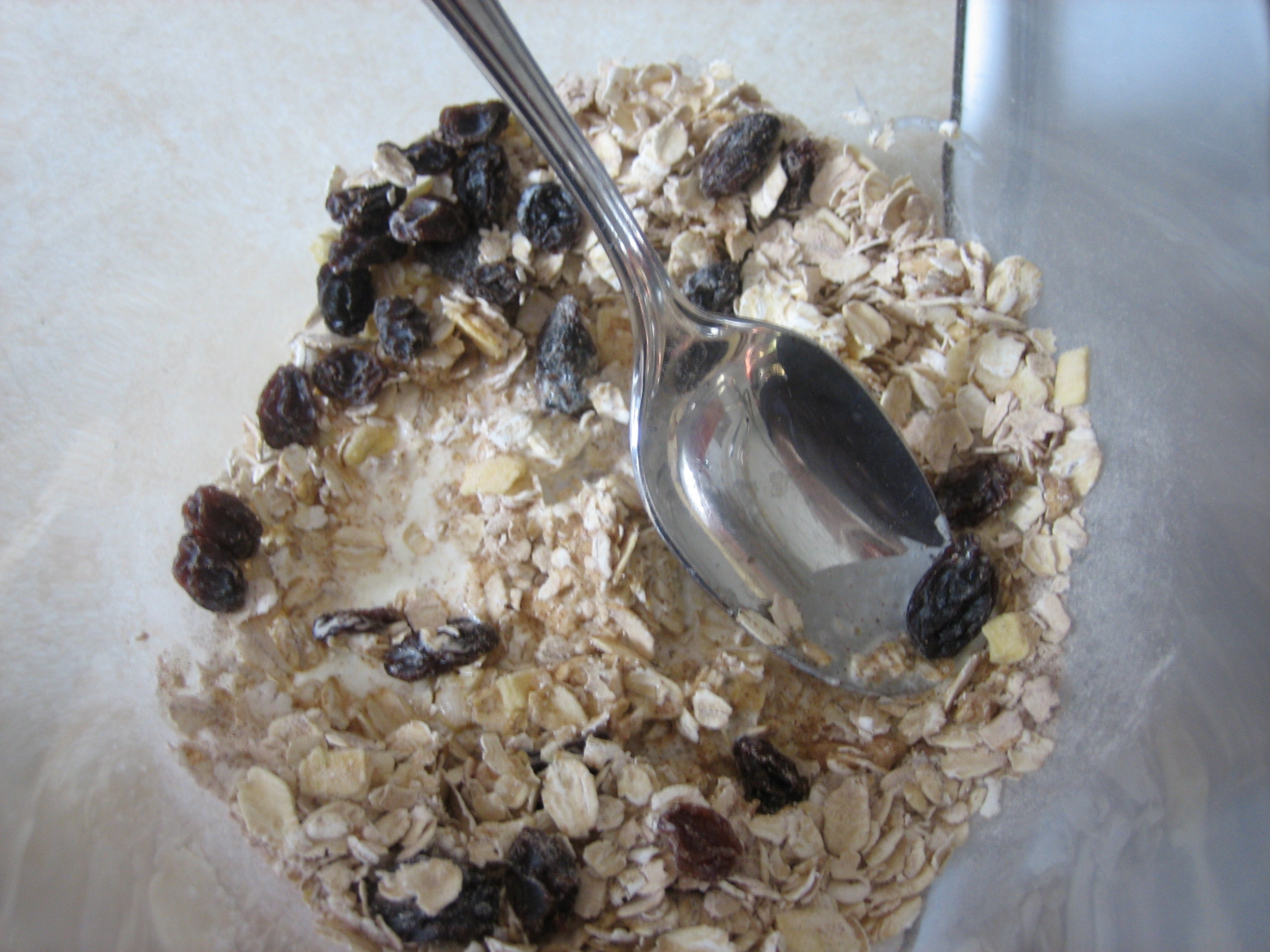
Ideally, one would use plain oats, and flavor them with a bit of cinnamon, brown sugar, and a pinch of salt, all moistened with milk.  Being out of oats on New Year’s Day, I resorted to a packet of instant oatmeal, apple and spice flavor.  I added a bit more cinnamon to the packet, moistened it with a bit of cream, and tossed in a few raisins.

I then halved the apples and cut out the core.  Into the resulting cavity, I rounded a tablespoon or so of the oatmeal mixture.  I dotted each apple with a bit of butter and then put them into a small casserole dish.

I poured a bit of boiling water into the dish (about 1/4″ or so) and covered the dish with foil.  I set the casserole in a preheated 375° oven for about 30 minutes, until the apples were tender, and then served them with a little warmed cream.

Greta’s Pancake (fka David Eyre’s Pancake)

Amanda Hesser wrote a column about this pancake in the March 25, 2007, edition of The New York Times Magazine.  I gave it try one day soon thereafter and have been making it ever since.  Well, perhaps I got us started, but in the past year or so, my nine-year old daughter has taken command.

This pancake is nothing more than eggs, flour, milk, and a little nutmeg, baked in the oven in a pan full of butter.  It is then topped with powdered sugar and lemon juice.  It’s a cinch to make, and the original recipe takes well to tweaking.  By the time I first showed Greta how to make it, I had already decreased the amount of butter called for and determined that a pinch of salt is a welcome addition.  Greta has increased the amount of nutmeg and to the recipe she adds her special stirring method.  I can’t tell you what she does, but her pancakes come out more billowy than mine every single time.  I’ve watched her, trying to uncover the secret of her technique,  but it evades me still.

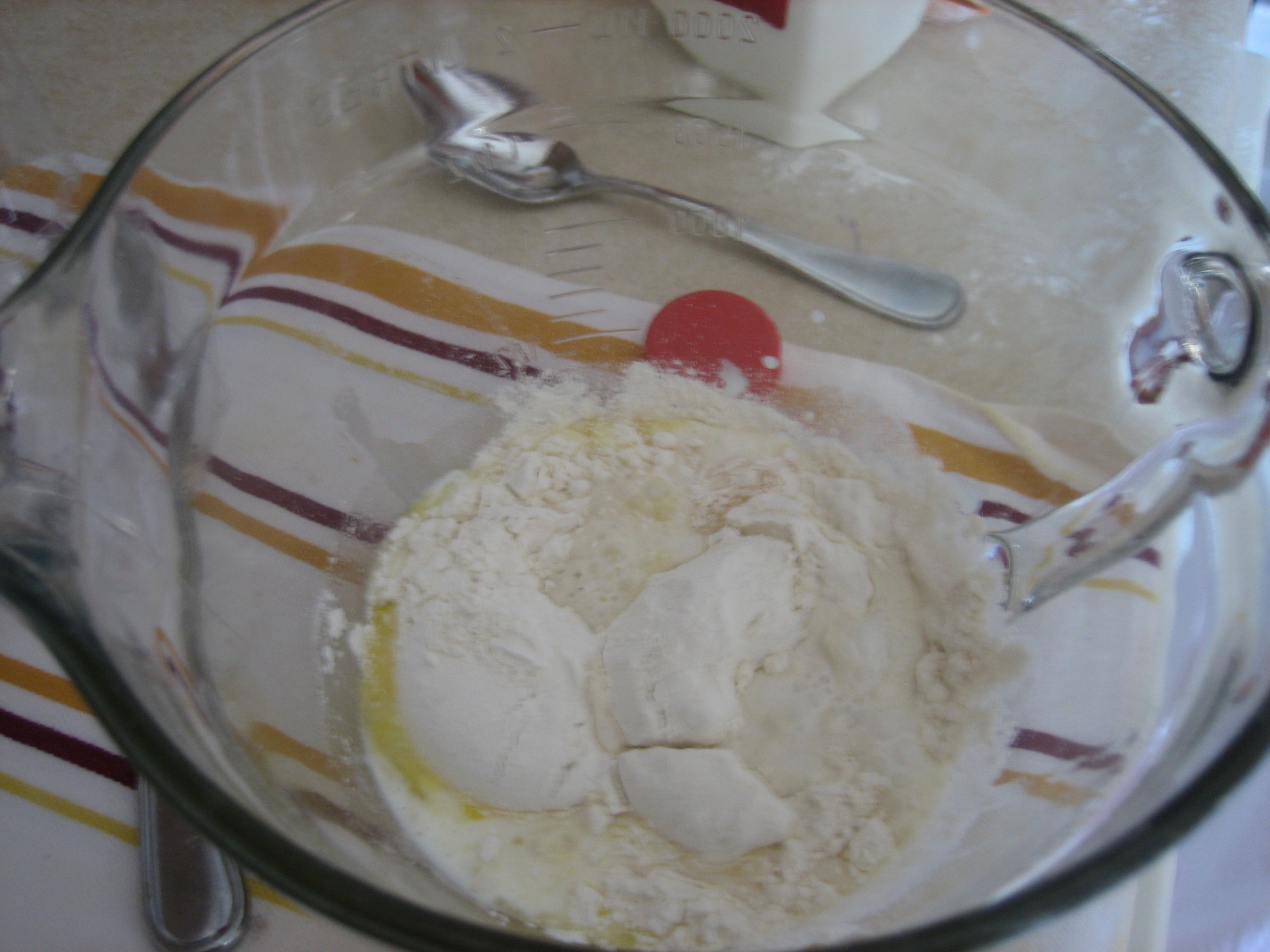
Today being New Year’s Day, Greta and I decided that it was an excellent day for her pancake.  I had also decided to prepare a batch of baked apples, something I’d been wanting to do ever since I’d been served one for breakfast at King’s Cottage during that Lancaster weekend.  Greta set to work beating a couple of eggs, and then added 1/2 c. flour, 1/2 c. milk, and a pinch of salt.

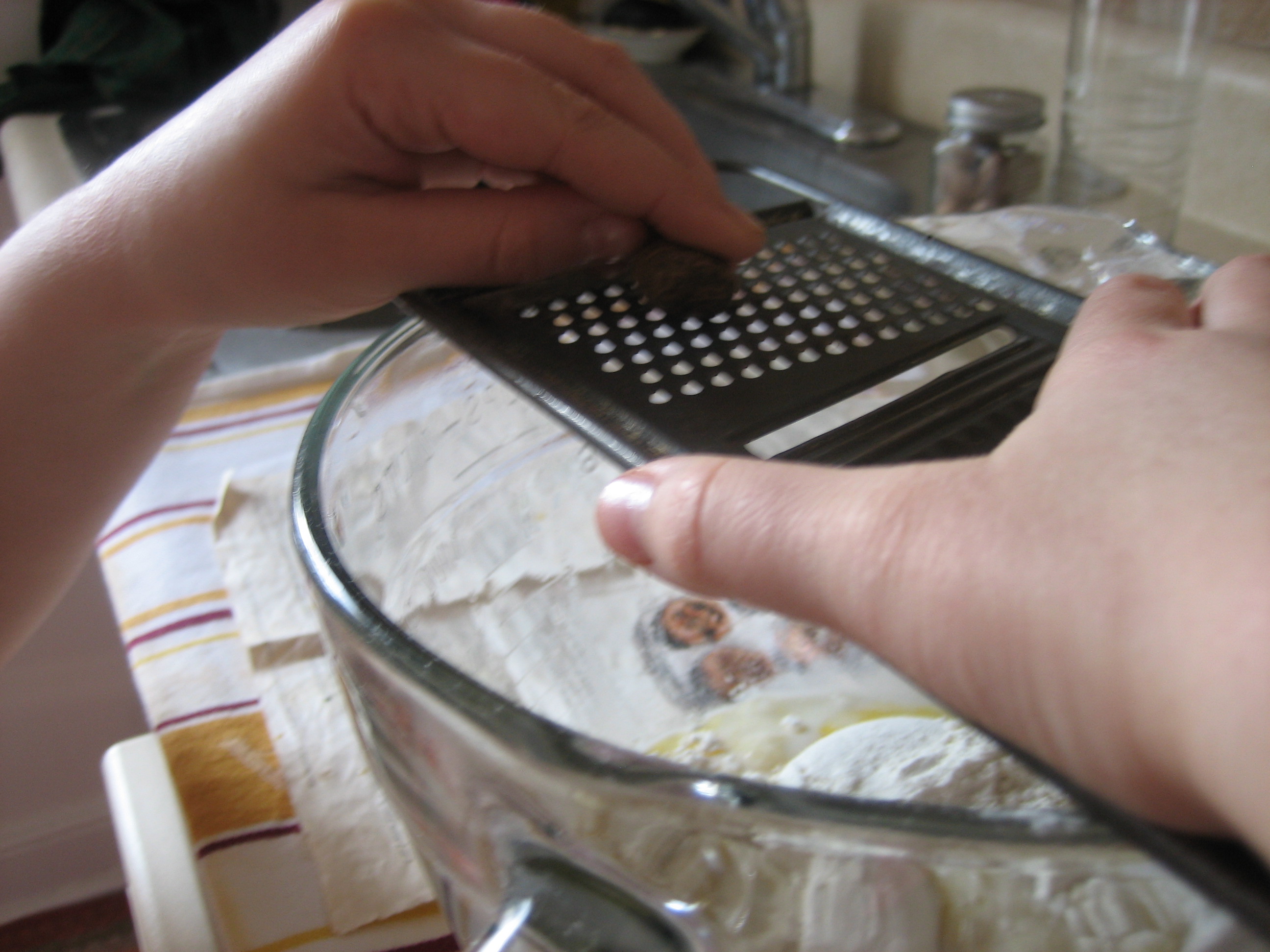
Next the fresh nutmeg -her favorite part.  Greta will tell you to “just grate it until you think you’ve put in enough.”

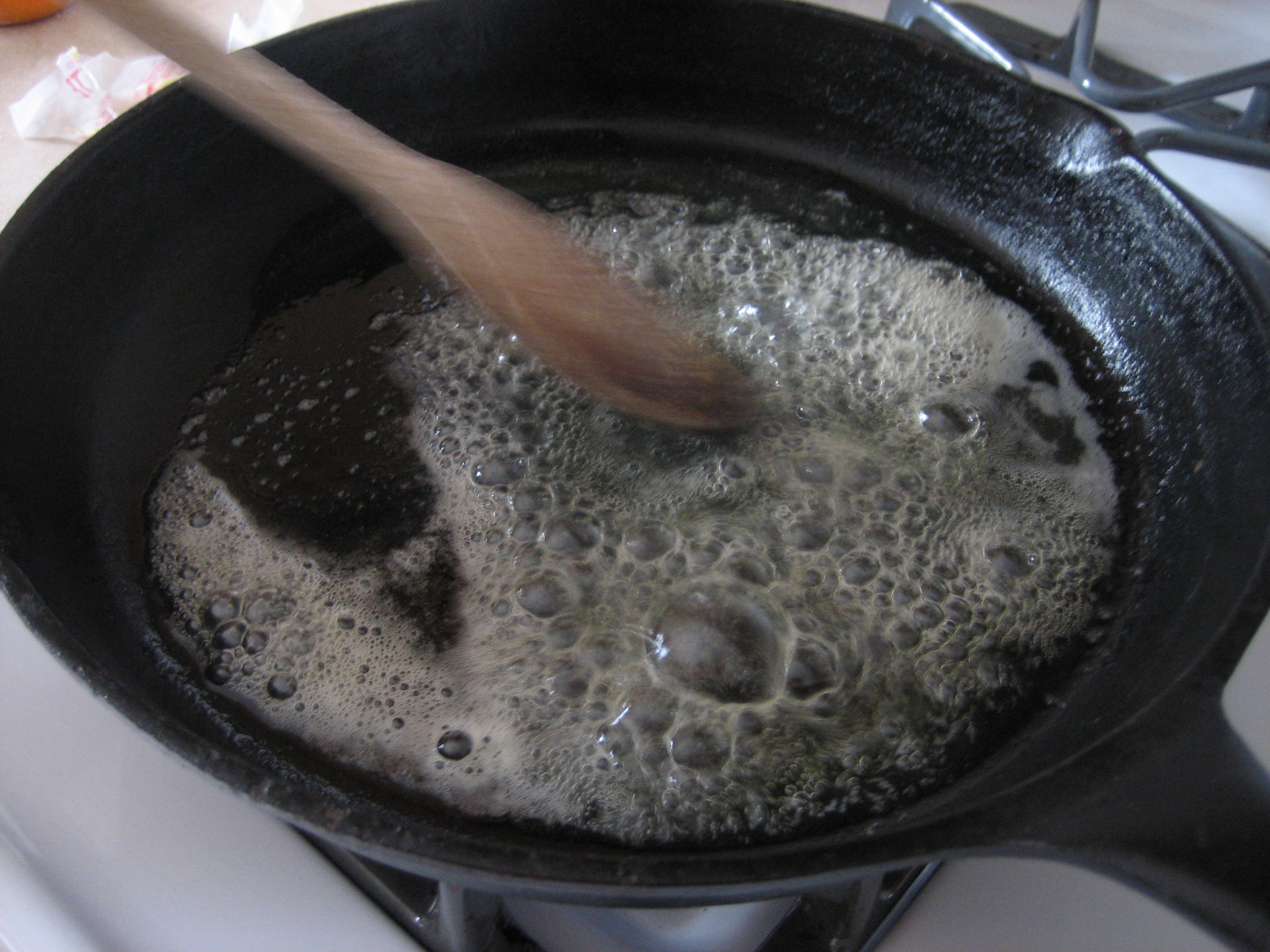
After the nutmeg, blend until only combined.  The batter should still be a little lumpy.  (This is where Greta excels.)  Next, melt 2 Tbs. of butter (or twice as much, if you’re so inclined) in an oven-proof skillet.

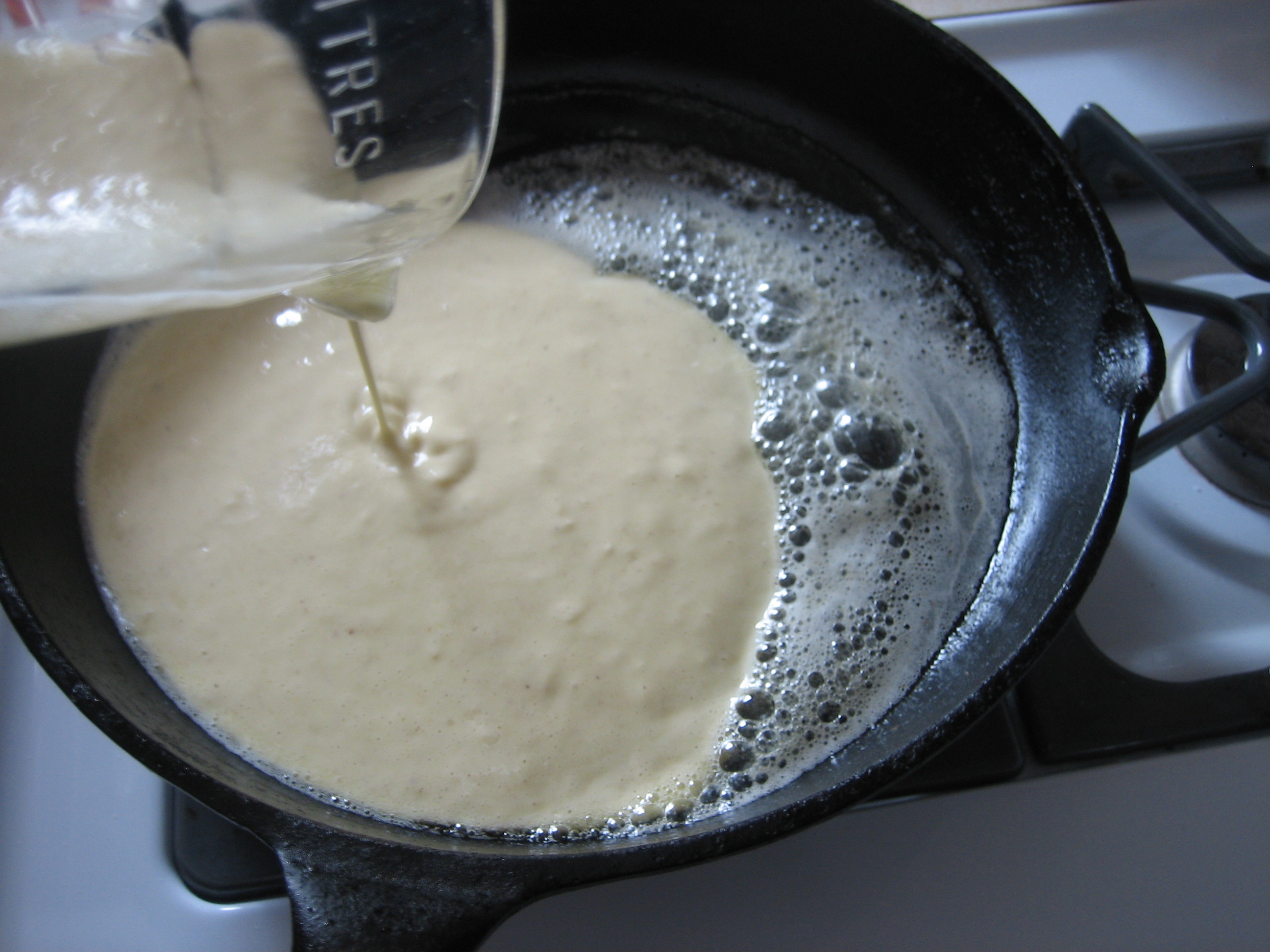
Pour the batter into the hot pan,

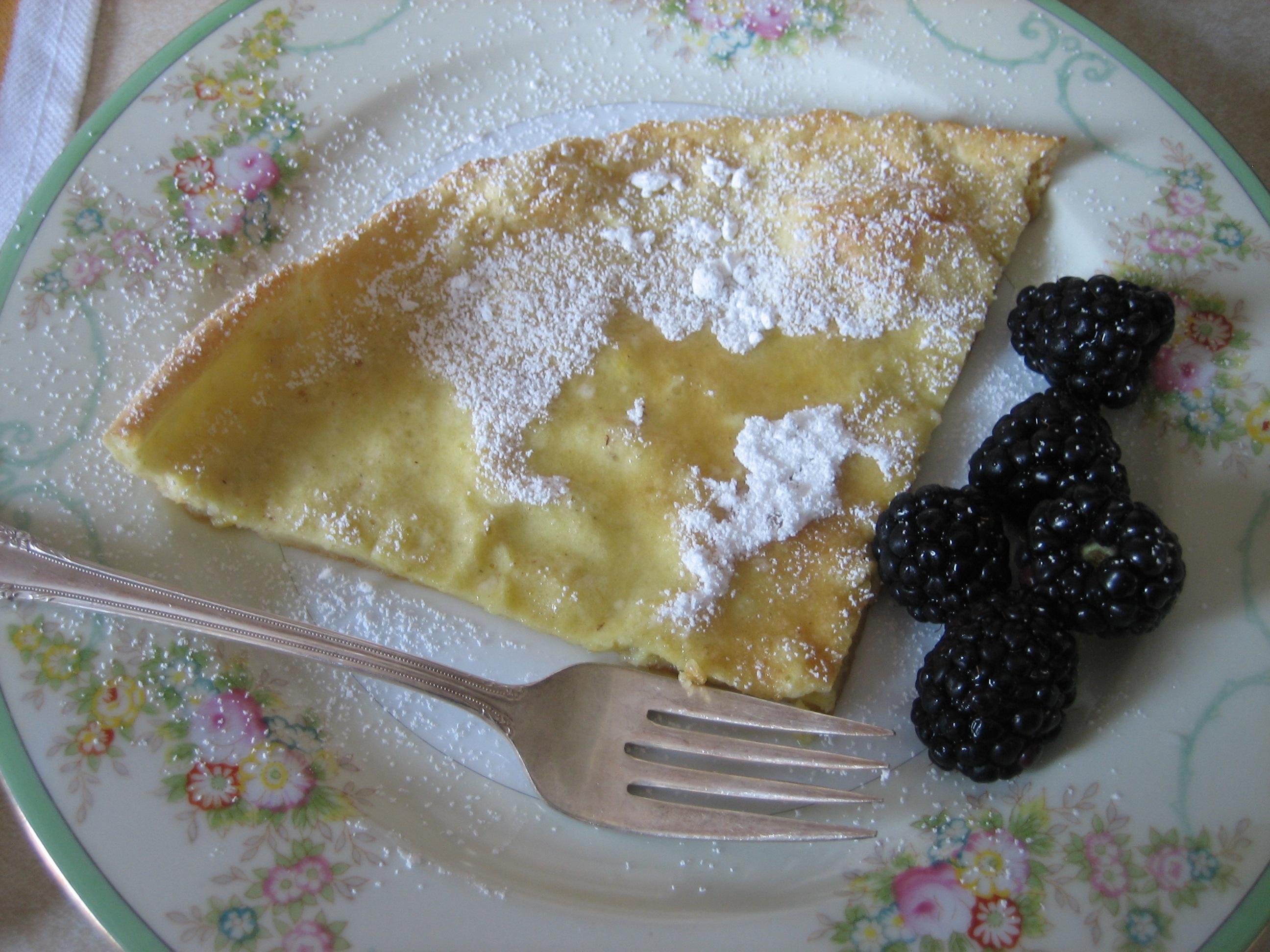
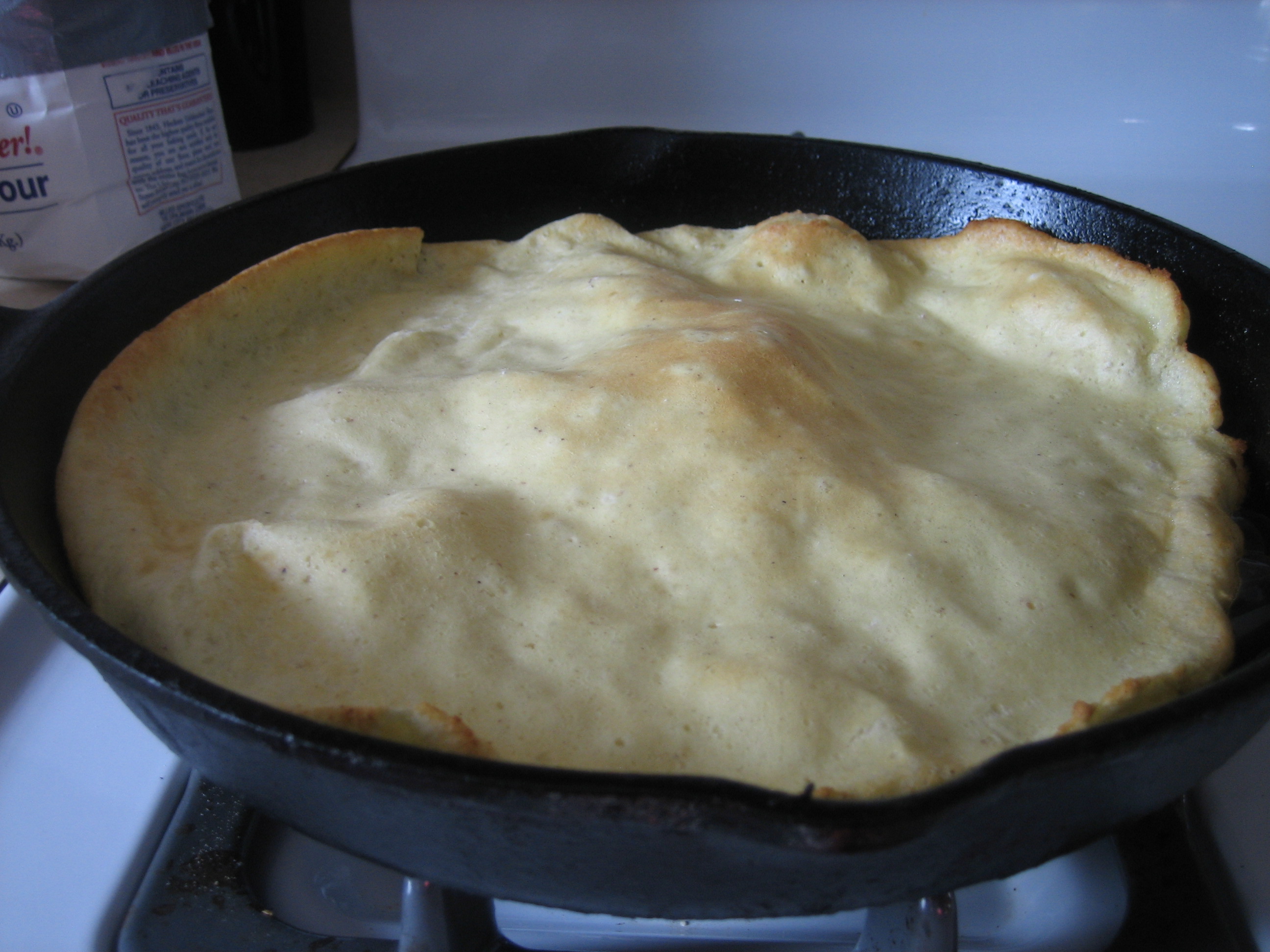
and set it in a 425° oven.  Bake approximately 12- 15 minutes.  The pancake should puff up, in billowy mounds, and should have a lovely golden color, even toasty on the edges.

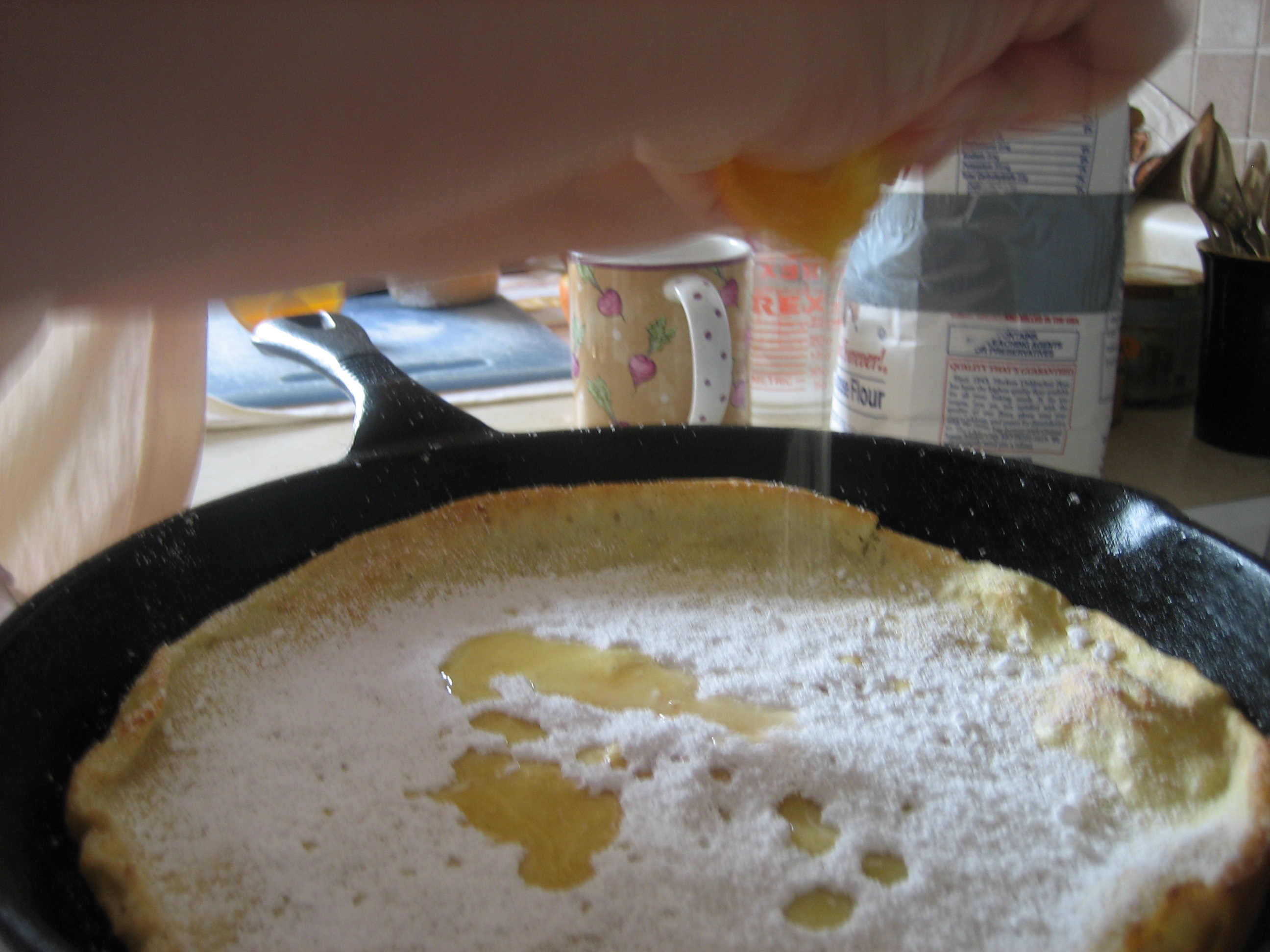
Remove pan from the oven and sprinkle to your heart’s content with confectioners’ sugar.

Next, we would normally sprinkle with the juice of half a lemon, but having discovered our fruit drawer remarkably bare of lemons, we decided to use an orange – and we loved it!

Cut the pancake in wedges and serve with berries, if you have them.  Jam or fruit butter might also be considered.

Next time:  the baked apples!

Two Cooks in the Kitchen

Confession:  I am one of those cooks who is a bit territorial in the kitchen.  Some of it stems from the fact that my kitchens have always been quite small and therefore difficult spaces in which to operate with more than one person.  But I’ll admit it, I also have a bit of a control issue in the kitchen.  I am an oldest child, and true to my birth order, do tend to believe that if  I want something done properly, it’s generally best to do it myself. (My sister would say “yes, you’re a know-it-all.”)   A number of recent events, however, have begun to move me in a new and surprising direction.

First was the “dinner is served” experience, though I believe things began to brew at the cheese counter on the evening of that salad and cheese dinner.   Next, the joint effort that resulted in the (largely) successful recreation of Effie Ophelia’s roasted carrot and fennel salad.  And then there was the double play of Christmas Eve.

I had decided to make spaghetti with Littleneck clams for our Christmas Eve lunch.  Dr. S was joining us, as my daughters had made an expressed request to spend some time with him, having had only a brief introduction to him one Saturday evening.

While he and the girls wrapped presents in the living room, I went about my business in the kitchen.  All was going well until I dug my spoon under the pile of Littlenecks, into the bottom of the pot to ladle out some broth.  To my horror, the broth was a deep and troubling gray, almost black.  I looked at the clams I had just spooned onto a dish of spaghetti and saw that one of them was filled with black mud, which had now spilled onto the spaghetti.  My cries of distress brought Dr. S to the kitchen.  After a peek in the pot, and a moment of thought, he asked if I had a gravy separator.  I did. While he poured the broth into the separator, I began to heat some oil and garlic, adding white wine and bottled clam juice, as a substitute sauce.  My level-headed friend suggested we stick the clams in a low oven to keep them warm in the meantime.

While the broth never did clear, it was an excellent idea and may well have worked if we had had more time.  Though not exactly the meal I had planned, the lunch was a success in the more important ways.

After the Christmas Eve Mass, my children left to spend the rest of the evening with their father and his family, and Dr. S and I headed to the home of good friends for a pre-dinner glass of wine.

Our menu for the evening was the same as my friend, Julie, had planned for her family –  Ina Garten’s Seafood Gratin.  While having our drink, Julie shared her frustration about how much prep time had been required.

“What?  I read that it takes only 20 minutes!”

“Ha!  It took forEVER to reduce that sauce!  And have you julienned the vegetables yet?  If you haven’t, you can forget about eating before 10.”

Well, as it happens, my physician had actually exercised his knife skills while the girls and I were at Mass.  But Julie is an experienced and good cook, so if this recipe had given her grief, there was reason to be concerned.

Once back in my apartment, we headed immediately for the kitchen. I began to clean the shrimp and prepare the scallops while Dr. S sautéed the leeks and carrots, started the sauce and picked through the lobster meat.  I chopped herbs then moved onto blanching the seafood while Dr. S melted butter and prepared the herbed breadcrumb topping.  While I reduced the sauce, the doctor sliced endive and whipped up a salad dressing.  Within 35 minutes we were sliding the casserole dish into the oven.  We sent Julie a text message 25 minutes later to let her know we were sitting down to dinner!

In my tiny railroad-style kitchen we had gracefully made this Christmas Eve dinner together.  And I had felt neither the need nor desire to provide my new kitchen companion with any instruction other than the next step in the recipe.

I think I could kinda love sharing my kitchen.

The Sincerest Form of Flattery

At my physician’s suggestion (and invitation), I recently spent a weekend exploring Lancaster County, PA.  While this little trip did nothing to improve my aforementioned chronic condition, it resulted in a number of delightful eating experiences.

After booking our room (the Duchess) at King’s Cottage Bed and Breakfast, Dr. S received from the owners a comprehensive list of nearby restaurants.  Aided by this list and the recommendations of the ever-helpful Chowhound message boards, we had pretty much decided on Effie Ophelia in downtown Lancaster for dinner the first night.  But when we learned that the restaurant was scheduled to close in just two weeks time, due to a job-related relocation for the chef’s spouse, the decision was sealed.  Of course we must eat there!  If not now, when?!  And upon strolling by and peeking in the windows on the afternoon of our arrival in town, we were gleeful in our choice. (OK, perhaps “gleeful” better describes my reaction, but Dr. S certainly agreed that it looked like a great spot.)  We saw an intimate space, seating only 30, made cozier by the dark wood of the interior, the cushioned benches, and the red velvet drape protecting diners from the opening and closing of the front door.   Anticipation for dinner now beginning to build, and having skipped lunch after having eaten a rather late breakfast, we rushed off for the sustaining distraction of a hot chocolate with whipped cream.

A few hours later we were seated in that candle-lit room, sharing our two first courses, and making mental notes as to how we could recreate one of them at home.  While the sea scallops served over a mound of whipped parsnip and pear puree were perfectly seared and comforting on what was a chilly night, it was the roasted carrot and chickpea salad that captured our full attention.

We had not expected that the salad would be served warm, but it was.  It arrived at the table in a perfectly round form, a low cylinder, about 2 1/2 inches high.  Jutting out from the compressed form of chickpeas, spinach and roasted fennel, were roasted carrot batons, and a spiral of honey curry vinegar circled the plate.  After a few bites, it was quite clear that this was an example of the whole being greater than the sum of the parts.   Nothing fussy was going on here, just simple roasted vegetables with this interesting honey curry dressing.  As much as we enjoyed the sugar barbecued pork loin and striped bass that came next, the carrot and fennel salad remained on our minds.

And so it was that two nights later we decided to try to recreate it as part of our Sunday night dinner.

Clearly the carrots and fennel had been roasted, but we weren’t sure what the treatment had been for the chickpeas.  Because we they were somewhat flattened and blackened on one side, we surmised that they, along with the roasted vegetables, had perhaps been seared on a flat griddle beneath a heavy spatula, and then everything spooned into a cylindrical mold.  Not having a griddle, I decided to just toss the chickpeas in to roast along with the carrots and fennel.  (This would turn out to be a bad move.)  Determining that the spinach would need only a quick wilting, we turned to the honey curry vinegar.

With the discovery that his cupboard was bare of curry, Dr. S made a “kitchen emergency” call to his neighbor, and returned bearing a restaurant kitchen-sized container of Madras curry, but also somewhat soggier due to the torrents of rain he had to brave in the process.  We mixed, we tested, we added, and we learned a few things:

Number one:  it’s helpful to heat the curry in a little bit of oil in order to best bring out the flavor

Number two:  it’s helpful to heat the honey a wee bit, as well.

Number three: mix the curry and honey first and add the vinegar (we used rice vinegar) drop by drop.  You want the consistency to remain honey-like.  The object is a sauce with a sweet, hot taste, zinged up with a bit of vinegar.

The vegetables done, we were ready to compose!  Foregoing any attempt at a mold, we served the dish as a traditional salad, with a drizzle of honey vinegar.  The result . . .

Success – almost!!!

As I alluded to above, the chickpeas had not been properly handled.  They were crunchy.  And though I understand that some folks like crunchy, roasted chickpeas as a snack, they were out of place here.  After discussion, Dr. S and I agreed that the next time they should be thrown in for only the last few minutes of roasting, or perhaps even just heated in a bit of (curried?) oil.  But other than that, we were pretty pleased with our experiment.  It was the first time either of us had tried to recreate something we’d eaten in a restaurant and it was great fun!  I do believe we may do it again.

Thanks, Effie Ophelia!

Create a free website or blog at WordPress.com.

Up ↑